
Every corporate lawyer has lived some version of this moment: a client asks whether a particular provision is market, and you pull up the last three deals you worked on, maybe ping a colleague, and give your best answer. It's informed by experience. But it's also informed by a tiny, biased sample of deals you happened to touch, dressed up as market intelligence.
With legacy DMS and simple text search, even pulling up those few samples is a nightmare.
The honest version of what we tell clients sounds more like: "Based on the handful of precedents I can recall and the two deals I have time to check before this call, here's what I've seen."
This is an inherent structural problem.
The Work That Never Gets Done
In every law practice, there are two kinds of work. There's the billable, urgent work - getting the deal done. And then there's longer-term infrastructure work. Building systems and processes, creating templates and playbooks grounded in actual data rather than individual memory.
Infrastructure work compounds. An associate who systematically analyzed how 100 merger agreements handle Material Adverse Effect carve-outs would be devastating in negotiations, armed with precise data about what's genuinely market versus what's an aggressive ask dressed up as standard.
But infrastructure work has a fatal flaw in law firm economics - it's not billable. No client is paying you to spend 50 hours reading other people's merger agreements. And even if they were, you don't have 50 hours. You have a signing deadline on Friday.
So the infrastructure never gets built. Knowledge lives in partners' heads, gets passed down through apprenticeship, and walks out the door when people leave. The profession's collective understanding of market standards ends up wide but shallow, built on anecdote rather than analysis.
What Data-Driven Has Meant Until Now
There are great resources out there for deal data, such as SRS Acquiom's M&A Deal Terms Study and the Cooley Go financing trends, but most of what's out there focuses on high-level business terms. Deal databases can tell you that the median termination fee in public company M&A was 3.2% of equity value last year. That's useful information for a negotiation, no doubt, but a lot of those details get fleshed out at the LOI-stage by the business principals; it doesn't help you draft a single paragraph.
The gap is in the drafting layer: the actual language, structure, and substance of provisions. How do different merger agreements define "Permitted Liens"? What's the range of approaches to interim operating covenants? How do fiduciary outs actually get structured across dozens of deals?
These questions matter in practice. And answering them requires reading and comparing tens of agreements provision by provision. That's systematic, exhaustive work at a scale that no human team can sustain.
What Changes When You Deploy Hundreds of Analysts in Parallel
Consider what becomes possible when AI takes on the infrastructure work. You can feed it a corpus of real M&A agreements (mergers, stock purchase agreements, asset purchase agreements), have it extract every section, cluster them into canonical provision categories, and produce a per-provision market analysis across the entire corpus. Actual analysis of what concepts appear, how common they are, how they vary, and how they're actually drafted.
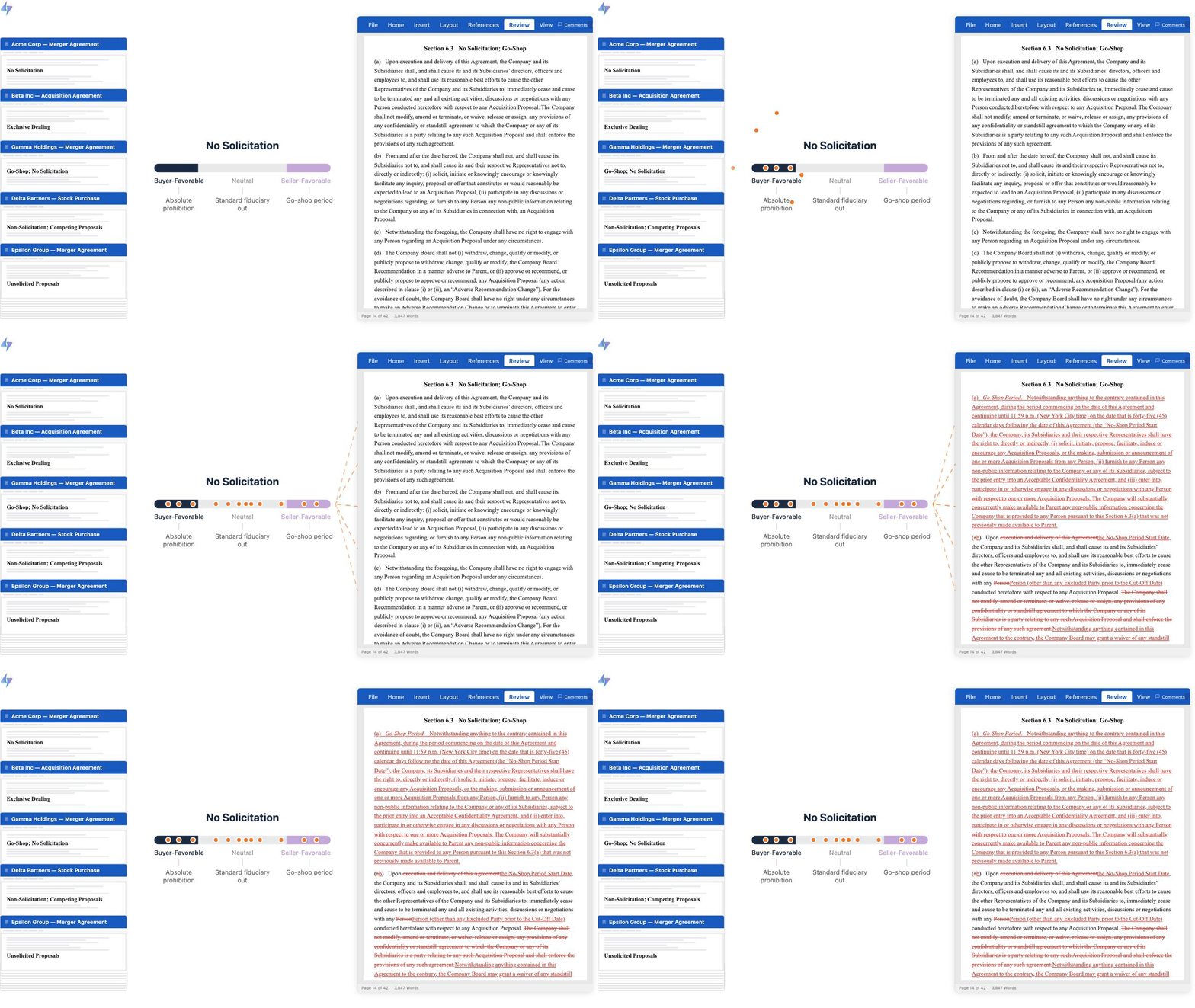
AI agents are becoming increasingly good at retrieving information from massive datasets. They are not bound by document structure or exact wording, and can spot semantic similarities to correctly group together equivalent concepts.
From Spot-Checking to Systematic Knowledge
Today, when a junior associate drafts a merger agreement's non-solicitation provision, they typically start with a precedent from the last deal their team closed, adjust it based on whatever guidance the partner provides, and maybe check one or two other precedents if time allows. The quality of the output depends heavily on the quality of the starting precedent and the partner's memory.
Compare that to an associate who can see, before they start writing, how non-solicitation provisions actually break down across the market: which concepts appear, how they range from buyer-favorable to seller-favorable, and what the typical middle-ground looks like.
The lawyer's judgment stays the same. What changes is the foundation under that judgment. Instead of extrapolating from whatever precedent happened to be nearby, you start with the full landscape.
And the data gets sharper the closer you get to your deal. Broad market analysis is the starting point, but the same approach can narrow to your client's own preferences, surfacing what they've accepted or pushed back on in past transactions. It can also surface your counterparty's (or its counsel's) past positions.
Where This Is Going
This kind of taxonomy work (mapping every provision, analyzing every variation) is foundation-laying. Once you have a structured understanding of how hundreds of provisions work across hundreds of deals, drafting stops being a single-precedent exercise, and can become a dynamic "plug and play", provision by provision, rather than anchoring to one deal and hoping it fits.
There's another dimension here. AI agents that draft or review contracts today typically work from general training data. They know what an indemnification clause looks like in the abstract, but they have no sense of what's market for a specific deal type or size. When an agent is grounded in structured market data, the output improves in ways that matter to practitioners. It hallucinates less, because it's drawing from real provisions. Its analyses are more informed, because it can reference where a given approach sits on the market spectrum. And over time, as lawyers interact with the system and shape what "good" looks like for their practice, the drafting becomes tailored to how they actually work.
Most of the current conversation around legal AI focuses on automating output: more contracts, more redlines, faster turnaround. That's valuable, but it misses the bigger picture. The real unlock is the infrastructure layer. Systematic market intelligence embedded into every stage of the deal process, where "market standard" becomes a precise, evidence-backed statement rather than a rough heuristic. And AI agents that are built on top of that infrastructure, rather than on generic training data, will be the ones that lawyers actually trust.
The infrastructure work that no one had time to do can finally be done, and it can be done cheap. And the lawyers who have it will practice differently than those who don't.